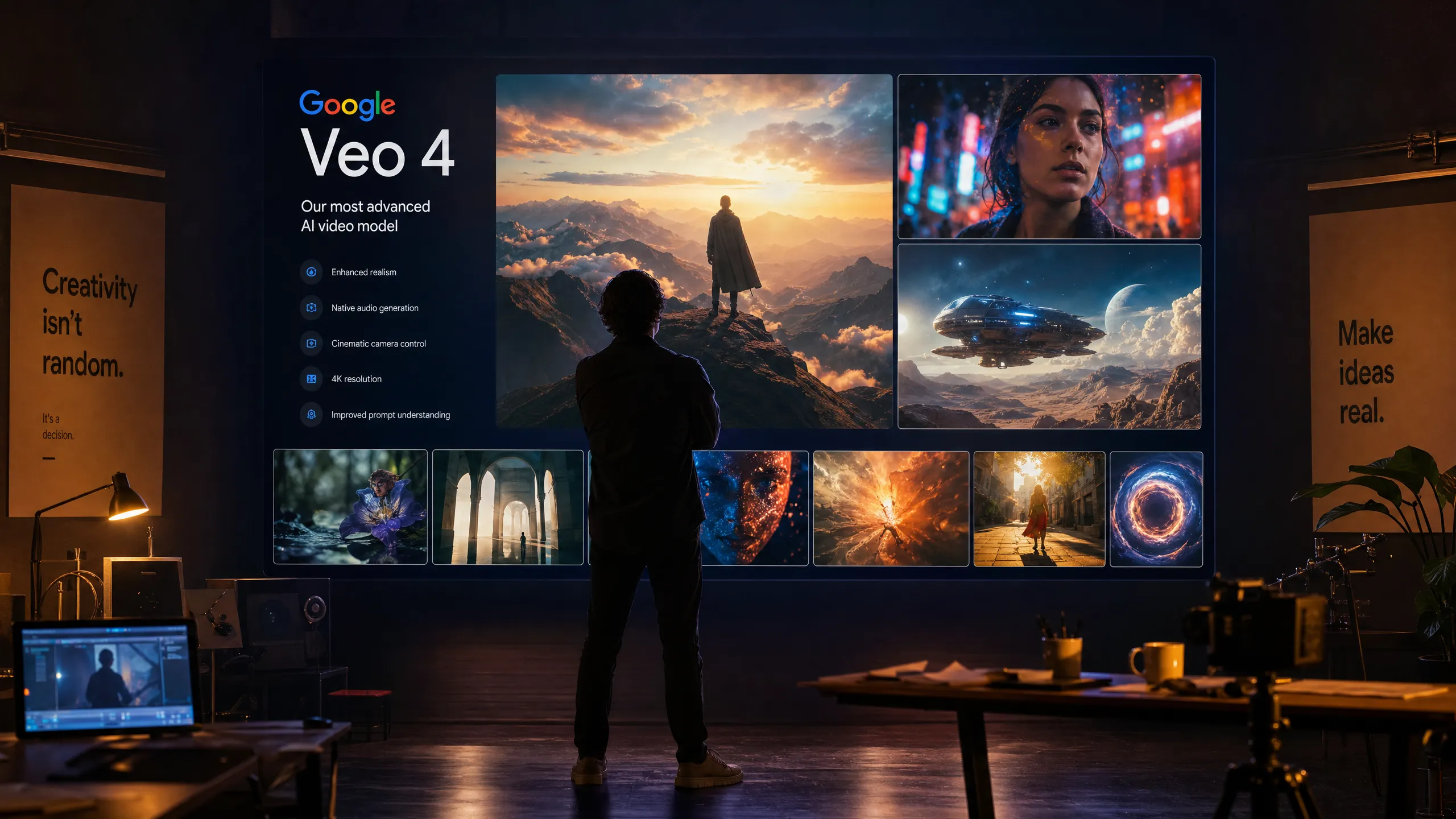
> For the complete documentation index, see [llms.txt](https://sharkfoto.gitbook.io/blog/llms.txt). Markdown versions of documentation pages are available by appending `.md` to page URLs; this page is available as [Markdown](https://sharkfoto.gitbook.io/blog/ai/what-is-google-veo-4-features-release-date-and-what-creators-should-expect.md).
# What Is Google Veo 4? Features, Release Date, and What Creators Should Expect
The artificial intelligence video generation space is highly competitive, with major tech giants racing to release the most capable models. Among the most anticipated releases of the year is Google Veo 4. Developed by Google DeepMind, Veo 4 represents the next major leap in multimodal generative AI, promising to bring true cinematic quality and narrative control to everyday creators.Whether you are a digital marketer looking to scale ad production, a filmmaker exploring new mediums, or a content creator wanting to elevate your visuals, understanding what Veo 4 brings to the table is essential. Platforms like [SharkFoto](https://sharkfoto.com) are already gearing up to support these next-generation models within their comprehensive AI media suites.In this guide, we will answer the most pressing questions about Google Veo 4, explore its groundbreaking features, discuss its expected release date, and outline what creators should expect when it finally drops.
### What Is Google Veo 4?
At its core, Google Veo 4 is a state-of-the-art, multimodal generative AI model designed to create high-quality, cinematic video content. It acts as a bridge between human imagination and professional video production, transforming simple text prompts, static images, or audio inputs into dynamic, photorealistic video footage.Unlike early AI video generators that produced short, glitchy, and silent clips, Veo 4 is built upon a completely overhauled architecture. It understands complex physics, lighting dynamics, and spatial relationships, allowing it to produce footage that rivals professionally shot content.Veo 4 is not just a "clip generator"; it is designed to be a "scene director," capable of understanding narrative flow and multi-shot sequences.
### Key Features of Google Veo 4
Google DeepMind has focused on solving the major pain points that creators experienced with earlier models like Veo 3 and [Veo 3.1](https://sharkfoto.com/ai/video/text-to-video/?model=veo-3.1). Here are the standout features you can expect from Veo 4:
#### 1. Extended Video Length (Up to 30 Seconds)
One of the most highly anticipated improvements is the ability to generate significantly longer videos. While previous models were often limited to roughly 8 seconds, Veo 4 can produce continuous, high-quality clips ranging from 10 to 30 seconds from a single prompt. This extended duration allows for complete scenes and comprehensive product showcases without the need for complex post-production stitching.
#### 2. Cinematic 4K Resolution
Veo 4 pushes visual fidelity to the professional standard by generating footage at resolutions up to 4K. Beyond just pixel count, the model boasts vastly improved temporal consistency. This means the flickering, morphing, and unnatural artifacting common in older AI videos have been virtually eliminated.
#### 3. Native Storyboarding for Narrative Sequences
This is perhaps the most revolutionary addition to Veo 4. Instead of generating isolated, disconnected clips, users can now define a sequence of scenes, camera angles, and narrative beats within a single workflow. Veo 4 will seamlessly transition from a wide establishing shot to a close-up, maintaining narrative flow and visual coherence throughout the entire sequence.
#### 4. Flawless Character Consistency
Maintaining a character's appearance across different frames and camera angles has historically been the Achilles' heel of AI video. Veo 4 introduces advanced character anchoring technology. Once a character is introduced, their face, clothing, and distinguishing features remain consistent, even during complex movements.
#### 5. Multimodal Input and Native Audio Generation
Veo 4 is a truly multimodal powerhouse. It accepts text prompts, image-to-video references, and even audio inputs. Building on the synchronized audio introduced in Veo 3.1, Veo 4 generates native, high-fidelity sound effects, ambient noise, and dialogue that perfectly match the visual action on screen.
### When is the Google Veo 4 Release Date?
As of early 2026, Google DeepMind has not officially announced a hard public release date for Veo 4. However, based on Google's historical release patterns for major AI models, industry experts have strong predictions.The official public launch of Google Veo 4 is widely expected to coincide with major Google developer events. The prime candidates are Google Cloud NEXT '26 (scheduled for April 2026) or the annual Google I/O developer conference (typically held in May 2026).Historically, Google uses these flagship events to unveil its most significant AI advancements to the world, making Spring 2026 the most likely window for Veo 4 to become available to developers and creators.
### What Creators Should Expect (And How to Prepare)
When Veo 4 launches, it will fundamentally change the AI video workflow. Creators should expect a shift away from "prompt engineering to fix glitches" toward actual "cinematic directing."Because Veo 4 handles physics, consistency, and resolution so well, the differentiator between a good AI video and a great one will be the creator's understanding of lighting, composition, and storytelling.How to prepare for the Veo 4 launch:1.Master Current Models: Spend time with Veo 3.1 or similar models to understand how AI interprets cinematic language (e.g., "tracking shot," "shallow depth of field," "golden hour lighting").2.Build Reference Assets: Veo 4's image-to-video and avatar capabilities will be powerful. Start building libraries of character reference images, brand assets, and style guides now\.3.Plan for Audio: Since Veo 4 generates native audio, start incorporating sound design into your prompts. Think about the ambient noise and foley effects that belong in your scenes.
### Conclusion
Google Veo 4 is poised to be a watershed moment for AI video generation. By solving the core issues of duration, consistency, and resolution, it will empower creators to produce professional-grade content at an unprecedented scale.When the model is released, integrating it into a streamlined workflow will be key. Platforms like SharkFoto, with their all-in-one approach to AI media creation, will provide the perfect environment to harness the full potential of Google Veo 4, combining its video capabilities with advanced image, audio, and editing tools. The future of cinematic AI is almost here.
---
# Agent Instructions
This documentation is published with GitBook. GitBook is the documentation platform designed so that both humans and AI agents can read, navigate, and reason over technical content effectively. Learn more at gitbook.com.
## Querying This Documentation
If you need additional information that is not directly available in this page, you can query the documentation dynamically by asking a question.
Perform an HTTP GET request on the current page URL with the `ask` query parameter, and the optional `goal` query parameter:
```
GET https://sharkfoto.gitbook.io/blog/ai/what-is-google-veo-4-features-release-date-and-what-creators-should-expect.md?ask=&goal=
```
`ask` is the immediate question: it should be specific, self-contained, and written in natural language.
`goal` is optional and describes the broader end goal you are ultimately trying to accomplish on behalf of the user. GitBook uses it to tailor the answer towards what is most useful for that goal.
The response will contain a direct answer to the question and relevant excerpts and sources from the documentation.
Use this mechanism when the answer is not explicitly present in the current page, you need clarification or additional context, or you want to retrieve related documentation sections.